
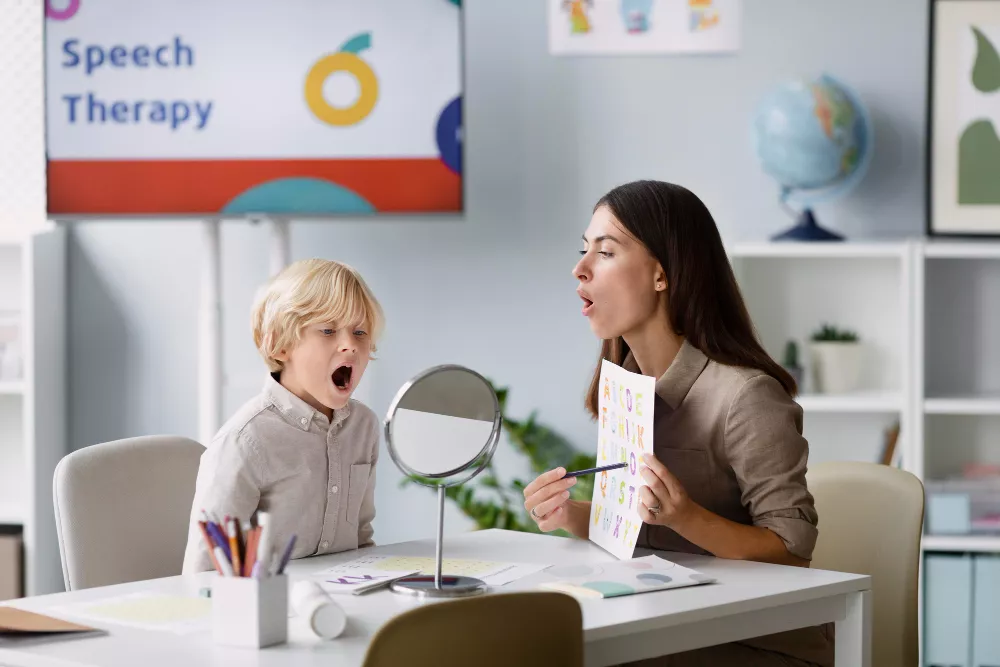
Speech Therapy supports children who experience difficulties with speech, language, fluency, pronunciation, understanding, or social communication.
Speech Therapy is not only about correcting pronunciation. It helps children understand language, express their needs, build vocabulary, form sentences, communicate socially, and participate more confidently in everyday conversations.
For some children, communication difficulties may affect learning, behaviour, confidence, friendships, or participation at school and home.
Therapy focuses on understanding the child’s specific challenges and building communication skills through structured, age-appropriate, and engaging activities.
Speech Therapy may be helpful for children who experience:
Delayed speech development
Delayed language development
Unclear pronunciation
Difficulty producing certain sounds
Limited vocabulary
Difficulty forming sentences
Difficulty understanding instructions
Stammering or stuttering
Difficulty expressing needs or emotions
Social communication difficulties
Reduced confidence while speaking
Communication difficulties associated with developmental conditions
Difficulty maintaining conversations
Oral-motor or speech coordination concerns
Each Speech Therapy session is planned according to the child’s age, communication abilities, developmental needs, and individual goals.
Activities may include picture-based exercises, storytelling, sound practice, vocabulary games, sentence-building tasks, conversation activities, role play, listening exercises, interactive games, and social communication practice.
Therapy is kept engaging so children can learn naturally while participating in enjoyable activities.
Some children know what they want to say but find it difficult to pronounce sounds clearly.
Speech Therapy may focus on:
Correct sound production
Pronunciation
Mouth and tongue placement
Word clarity
Speech intelligibility
Sound sequencing
Speaking at an appropriate pace
Regular practice can help children produce sounds more accurately and make their speech easier for others to understand.
Language development includes both understanding what others say and expressing thoughts clearly.
Therapy may help children improve:
Vocabulary
Sentence formation
Grammar
Understanding questions
Following instructions
Describing objects and events
Expressing ideas
Answering appropriately
Storytelling
Conversation skills
These skills are important for learning, classroom participation, and everyday communication.
Children who stammer or hesitate while speaking may become self-conscious or avoid communication.
Speech Therapy may include strategies that support smoother communication, controlled speech, breathing, pacing, and confidence.
The aim is not only to improve fluency but also to help children feel more comfortable and confident when expressing themselves.
Communication also involves knowing how and when to interact with others.
Speech Therapy may support children who find it difficult to:
Start conversations
Maintain conversations
Take turns while speaking
Ask and answer questions
Understand social cues
Use appropriate tone
Maintain attention during interaction
Communicate with peers
Express feelings appropriately
These skills can help children participate more confidently at school, during play, and in social environments.
Children often learn communication skills more effectively when therapy feels enjoyable rather than repetitive.
Sessions may use toys, games, stories, pictures, songs, role play, visual prompts, and interactive activities to encourage active participation.
The therapist may gradually increase the complexity of tasks as the child becomes more confident.
Parents and caregivers play an important role in strengthening communication skills.
Families may receive simple strategies to practise at home, such as:
Encouraging conversation
Reading together
Naming everyday objects
Expanding short sentences
Practising target sounds
Asking simple questions
Giving the child time to respond
Encouraging eye contact and turn-taking
Reinforcing new vocabulary during daily routines
Consistent practice helps children use newly developed skills outside the therapy environment.
Every child communicates differently. Speech Therapy is personalised according to the child’s developmental level, communication strengths, specific difficulties, and functional goals.
Progress is reviewed regularly, and therapy activities are adjusted as communication abilities improve.
When appropriate, Speech Therapy may work alongside occupational therapy, behavioural therapy, physiotherapy, counselling, special education, or other developmental services to provide coordinated support.