
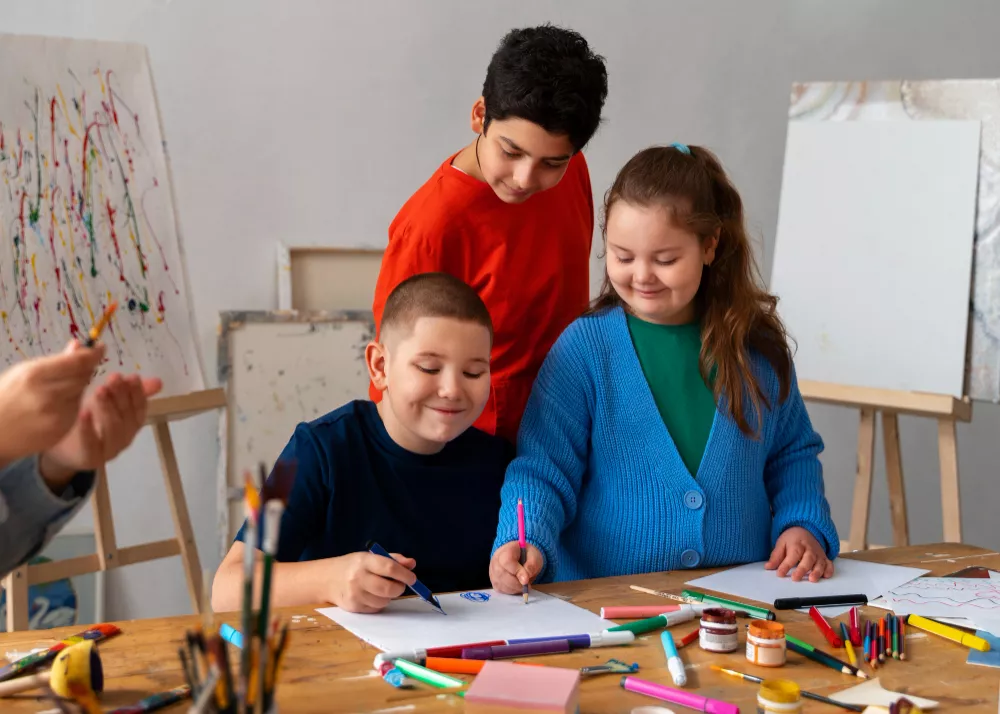
Special education provides individualised learning support to children with diverse developmental, learning, communication, and behavioural needs. Through structured teaching methods and personalised educational strategies, it helps children build academic skills, improve communication, develop independence, and participate more confidently in learning environments.
Every child has unique strengths, interests, learning styles, and challenges. Some children may need additional support to understand concepts, develop foundational academic skills, follow instructions, or adapt to classroom routines.
Our approach focuses on identifying each child’s learning needs and creating supportive educational experiences that encourage participation, confidence, and gradual progress.
Special education may benefit children who experience:
Learning difficulties
Delays in academic development
Difficulty with reading, writing, or mathematics
Challenges with attention and concentration
Communication and language difficulties
Difficulty following instructions
Developmental delays
Autism-related learning needs
Intellectual or cognitive disabilities
Challenges with memory and problem-solving
Difficulty adapting to classroom routines
Needs for individualised educational support
Special education focuses on developing the skills children need to learn, communicate, and participate more independently.
Support may include:
Early learning and school readiness
Reading and writing skills
Basic numeracy and mathematical concepts
Attention and concentration
Memory and problem-solving
Following instructions
Communication and comprehension
Social interaction and classroom participation
Daily living and functional skills
Developing independence in learning tasks
The aim is to make learning more accessible, meaningful, and suited to each child’s abilities.
Children learn in different ways, and a single teaching approach may not meet every child’s needs. Special education uses structured activities, visual aids, repetition, task-based learning, and other appropriate teaching strategies to support understanding and skill development.
Learning goals are adjusted according to the child’s current abilities, progress, and individual educational needs.
Learning involves more than academic achievement. Children also need opportunities to develop confidence, express their needs, follow routines, make choices, and complete tasks independently.
Special education encourages these abilities through positive reinforcement, achievable goals, and consistent support. Recognising small achievements helps children build motivation and a more positive attitude towards learning.
Family involvement plays an important role in reinforcing learning beyond educational sessions. Parents and caregivers may receive practical guidance on supporting learning activities at home, establishing routines, encouraging communication, and promoting independence.
This helps create consistency between the child’s learning environment and everyday family life.
Where appropriate, special education can be coordinated with occupational therapists, speech and language therapists, physiotherapists, behavioural therapists, psychologists, and other professionals involved in the child’s development.
Working together helps align educational goals with the child’s broader developmental needs.
Progress looks different for every child. With individualised teaching, consistent encouragement, and family involvement, children can develop meaningful learning skills, greater confidence, and increased independence at their own pace.